
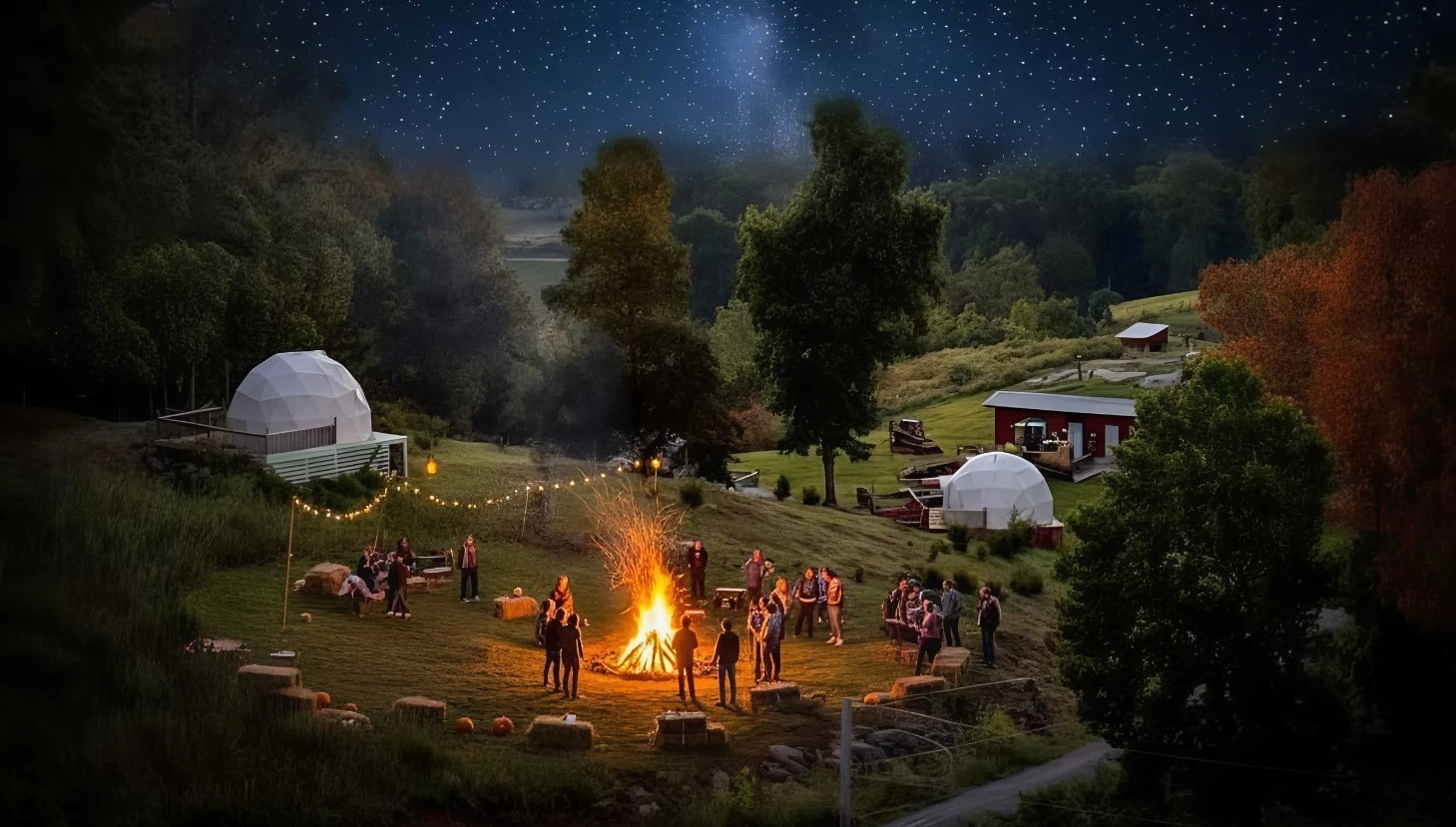
Breathtaking with Summer Stargazing at Carven Hills 2025
On stargazing summer nights at Carven Hills – from around June to early August – if the skies are clear, you can see the Milky Way stretching like a silver ribbon across the heavens. Familiar constellations come into view: Cygnus the Swan, with its bright star Deneb; Lyra hanging nearby with dazzling Vega; and Aquila soaring across the sky like an eagle – together painting a celestial map above the Virginia plains.
Evenings begin when the sun dips below the horizon, leaving a faint glow that fades from pale blue to deep indigo. When the moon is new or not too bright, the sky turns darker and deeper – that’s when more stars reveal themselves, unhindered by the glow of distant cities.
1. The Seasons and Their Unique Charms

Under favorable weather and environmental conditions, each season of the year offers its own ideal moments for stargazing and exploring the wonders of astronomy.
Spring / Early Summer: After May, the nights grow warmer and clearer. Constellations such as Bootes, Corona Borealis, and Hydra appear around 9 p.m.
Late Summer & Early Autumn: Summer constellations remain visible, but Orion begins to rise in the early morning hours – its brightest stars signaling the turn of the seasons. Mid-August brings the Perseid meteor shower, one of the year’s most anticipated celestial events.
Autumn & Winter: The air turns crisp and clear. If the sky cooperates, Orion shines most brilliantly now, along with Taurus, Gemini, and the bright stars of Canis Major, best seen around 8-9 p.m.
2. Light Pollution at Carven Hills
Set in rural Virginia, Carven Hills enjoys the gift of true night – far from the city lights. While areas near main roads or bright lamps may affect visibility, choosing a higher, darker spot within the property will reward you with a stunning view of the stars. Guests are encouraged to switch off outdoor lights when stargazing, allowing their eyes to adjust naturally to the dark and revealing countless stars otherwise unseen.
3. The “Sky Night” Experience

To share the beauty of the night sky, Carven Hills hosts the “Sky Night” program on clear evenings in July and August. Astronomy guides introduce the star map, help identify constellations, and show how to use binoculars or small telescopes.
Guests are invited to lie on outdoor blankets beneath the moonlight, listening to the soft hum of crickets and the rustle of the summer breeze while letting their eyes open to the vastness above. On certain nights, you might even catch the spectacle of a meteor shower streaking across the horizon.
The evening ends with warm tea or s’mores by the campfire – because sometimes, a night under the stars isn’t just a moment in time, but a memory to keep.
4. Constellations to Find in the Virginia Summer Sky

4.1. Cygnus – The Swan
As summer nights deepen, Cygnus dominates the center of the sky, its cross-shaped wings spread wide. Deneb shines bright, guiding your gaze along the Milky Way where clusters of faint stars sparkle like tiny jewels scattered in the dark.

4.2. Lyra – The Lyre
Hovering near Cygnus, Lyra is marked by Vega, a diamond of light against the night. Though small, this constellation hides the ethereal Ring Nebula – a faint halo of gas and dust, a celestial wonder even a small telescope can reveal.

4.3. Aquila – The Eagle
Aquila soars high, its wings spanning the summer sky, with Altair gleaming at its heart. It’s easy to imagine a great eagle gliding through the Milky Way, bringing life and motion to the stillness of night.
4.4. Scorpius – The Scorpion
Look south, and Scorpius emerges – its red heart, Antares, glowing fiercely in the dark. The curve of its tail, lined with bright stars, gives the impression of a mythic creature drifting slowly above the Virginia plains.

4.5. Sagittarius – The Archer
Low on the southern horizon, Sagittarius forms a distinct “teapot” shape. Around it lies the densest region of the Milky Way – the very heart of our galaxy. To gaze at it is to peer into a cosmic labyrinth of stars and nebulae, both mysterious and magnificent.

5. Preparing for the Perfect Stargazing Night

To truly enjoy the Carven Hills night sky, a little preparation goes a long way. Choose a night near the new moon or crescent phase, when moonlight won’t outshine the stars. Check the weather forecast – even a thin layer of cloud can blur the heavens.
Bring a blanket or reclining chair so you can lie back and look straight up. A light jacket, a thermos of tea, or a cup of hot cocoa makes the night air more comfortable.
To make your stargazing night even more rewarding, try using a star map app such as Stellarium, Sky Guide, or Star Walk 2. Simply lift your phone to the sky, and the app will automatically identify the constellations, planets, and bright stars visible from your exact location. It’s a wonderful way to both see and learn — you’ll notice how the patterns on the screen align beautifully with the real night sky above. If you’re with friends or children, this becomes more than just stargazing; it’s a shared moment of curiosity and quiet wonder under the stars.
Don’t forget a red-light flashlight – it lets you read star maps or adjust gear without losing your night vision. If you have binoculars or a small telescope, bring them along; even basic ones can reveal hidden star clusters or the faint ribbon of the Milky Way.
Before you begin, turn off all nearby lights and give your eyes 15-20 minutes to adapt to the dark. You’ll soon notice the sky slowly glowing in its own quiet way – not with electric light, but with the awakening of countless distant suns.
6. When Heaven Truly Opens

In the stillness of the Virginia plains, when every sound falls away, Carven Hills unveils a sky that silences you – not with awe, but with peace. There’s something humbling in realizing you’re part of a living, breathing universe, vast and endless above.
Perhaps that’s why a night of stargazing here isn’t merely an activity, but a moment of return – to slower rhythms, to stillness, to the simple act of looking up. As you lie beneath the Milky Way arching like a silver river overhead, you might understand that paradise isn’t somewhere distant. It’s right here – open wide, waiting to be seen.


